

When we, culturally, unloose and share our libidinous, mysterious, and starstruck fascinations upon the images we make with each other ...

(Above: Joseph Cornell's Rose Hobart; Patrick Bokanowski's L'Ange; Luis Buñuel's Subida al cielo)
... is there something tangible we can get from this exercise of free expression and the recounting of dreams? Aside from the pleasure of that expression itself? Can we craft our stories and images to do what we want, socially? Well, obviously, we can and do, within limits--but what are those limits? Once we have started using a disruptive, disjunctive impulse to patch together new artworks that examine our social mores and patterns ...
(Vera Chytilova's Daisies)
... or our individual, psychic perceptions ...
(Carl Th. Dreyer's Vampyr)
... or our collective psyche (does it ever emerge with a clean bill of health!?) ...
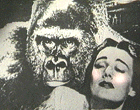
(Alexander Kluge's The Eiffel Tower, King Kong, and the White Woman)
... can we really ever be assured of the revolution (of whatever magnitude and stripe we expect) we feel we've been promised? Does Makavejev urge us to fuck as a way of getting the revolutionary ball rolling or does he think seeing his films about--among other things--fucking will do the trick (now this is a question more easily answered with some simple research, though)? In other words, what are the real differences when a viewer sees a film that plays up its performative enunciation ('I am a film that is out there attacking or promoting something through my very presence') versus a film that seems to promote action at expense of itself ('I, as a film, am invisible and unreadable beyond being a call to action')? To ask a related question [which Marcuse tackles], is great art always potentially subversive and productive [if so what is great art!?] ... or is there something that politically-minded observers must be sure to separate when dealing with art, since something great might also be something bad?
My temperament in this case is cautious and a little pessimistic--my suspicions are that art (and aesthetic experience as a category within experience) are not essentially, not even always potentially, "productive" or "positive" sites for the human being. Whatever is deemed good or bad for people, art can and does do both.
Mayakovsky charged that the bourgeoisie were subconsciously afraid of the electricity (the force) they had invented--they ate by candlelight (quotation found here). If the larger project of surrealism, for instance, which melded waking, rational reality with the streaming mental reality of the subconscious, what ways can we make sure that we're not just unleashing some more latent force or invention of ruling interests? I'm not trying to even skirt with a 'vulgar Marxism' here, as though that which is suspected to be "bourgeois" is bad and deserves to be destroyed or ignored. I'm only caught inside a question: how can I be sure when and where my fantasies are my own? Will it really be a case of the the unconscious breaking through our false consciousness (maybe the first impulse of the surrealist-marxist) or will our conscious, rational minds have to save us from our own socially-constructed desires? Probably what is needed is a dynamic balance between the two. And when it comes time to construct or consume images, sounds, narratives ... we're left with a vital necessity to think on-the-fly, case-by-case, provisionally, with a pragmatic and somewhat relativistic rigor.
Which brings me back to where I've started, really, and I have the feeling that in climbing the saddle between the giant mountains of Social and Aesthetic Theory, I've done nothing more strengthen my grip on the rocks I'm already holding for dear life. (Which is precisely why I'm blogging on this subject rather than publishing on it, at this moment in time.) Still, there were some pretty film frame enlargements along the way, right?





0 Yorumlar